Service · Dance & Group Fitness Recovery · Buford GA
Rest. Recover. Dance. Stretch. Strengthen. The five-piece rhythm of a body that is still on the floor at 70. We do the clinical lanes. You do the dance. We work the rest with you.
Dance is one of the strongest movement modalities for longevity. Cardiovascular, cognitive, and mental-health gains the literature credits to it run past what pure aerobic exercise produces. To collect on that math, the body needs all five pieces in rotation. Rest. Recover. Dance. Stretch. Strengthen. Skip one consistently and the math breaks.
Our work is to support the five-piece rhythm with the same recovery operating system we bring to pro athletes. Joe leads the load and strength side. Corie leads the women's-health lane. The dance is yours.
The rhythm
Most dance-fitness people do one piece extremely well. The dance. The other four are where the longevity is won or lost. The Method is built around all five.
/ 01
The night before the class.
Sleep is the foundation, and the variable everyone underplays. Seven to nine hours, with one true rest day per week. The body's biggest recovery system runs while you are not paying attention.
Yours Sleep windows, true rest days. Ours A read on what your week looks like and where to put the rest day if you do not have one yet.
/ 02
The clinical lane.
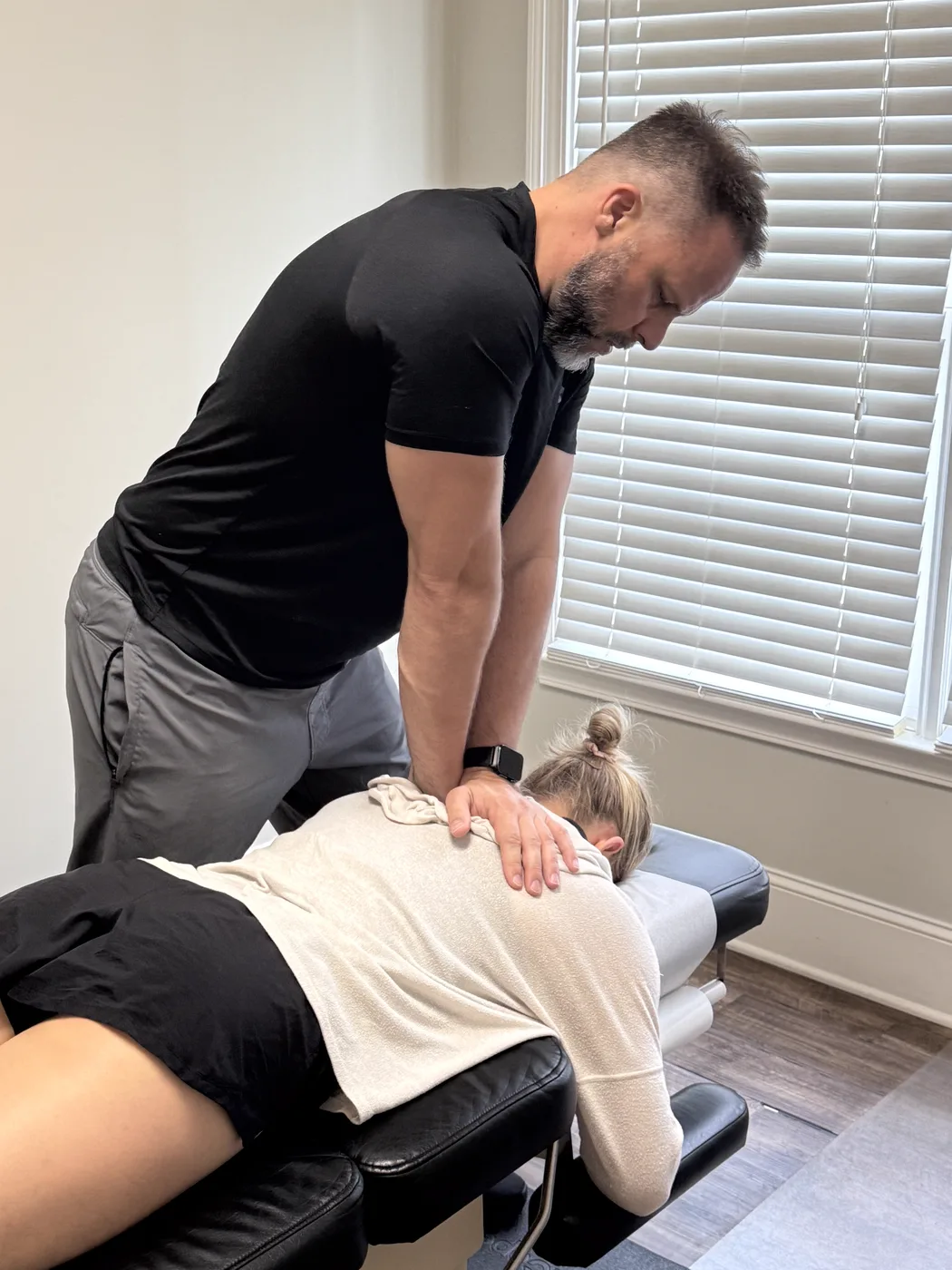
The hands-on side. Soft tissue, mobilization, adjustment, instrument work where the screen says it is needed. Plus active recovery you can run at home. This is the lane sports chiropractic was built for.
Ours Visit work plus prescribed home protocols. Yours Show up. Run the home work.
/ 03
The joy. The math. The point.
Dance is the piece you came for and the piece the longevity literature credits hardest. The job is to keep it in your life for the next thirty years, not to do as much of it as humanly possible this month. Volume is a setting, not a virtue.
Yours Show up to the floor. Ours Help you set the volume.
/ 04
Before, after, between.
Dynamic before. Static after. Mobility on off days. The Pre-Class Primer is the flagship version. Seven minutes, the strongest prevention work in sport.
Ours The Primer plus the joint-specific blocks (knee, ankle, hip, foot, low back). Yours Run them before class.
/ 05
The one nobody likes. The one nobody skips.
The single most under-prescribed input in dance fitness. Twice-weekly resistance work for the quad, hip, glute, and trunk. Not heavy. Not long. Honest. This is the input that protects the next decade of dancing.
Ours The Knee, Ankle, Hip, Foot, and Back blocks of The Method are the prescription. Yours Twice a week. We will tell you how heavy.
The literature
Dance is one of the strongest modalities in the longevity literature. The injury data is what tells us how to dose it. Both numbers belong on the page.
A pooled UK cohort of 48,390 adults found moderate-intensity dancing had a cardiovascular mortality hazard ratio of 0.54. Walking at matched intensity scored 0.67. Dance is a longevity sport.
Merom et al., American Journal of Preventive Medicine, 2016
An 8-week dance fitness RCT in sedentary adults produced a 3.1 mL/kg/min gain in VO2max. A 1 MET (3.5 mL/kg/min) cardiorespiratory gain is associated with a 10 to 25 percent lower all-cause mortality in cohort literature.
Domene et al., J Sports Sciences, 2016
Standard dance fitness classes run at approximately 7.3 METs, the same intensity range as jogging and cycling. By the Compendium of Physical Activities definition, this is vigorous-intensity exercise.
Compendium of Physical Activities · Ainsworth et al.
Compared to participants. Approximately seven times greater odds of injury for the instructor running the class than for the person taking it. This is where load management and strength work earn the most.
Domene PA et al., J Sports Sciences
Vs. 16 percent for participants. Six out of ten instructors sustain at least one injury in a year of teaching. The five-piece rhythm is the way out of that number.
Domene 2014 · surveillance, female ZIN instructors and participants
Twenty-eight percent prevalence among fitness instructors. Eighty-six percent of those affected had never sought professional advice. We ask about it because we can do something about it.
Goss et al., J Public Health, 2019
What this care adds
Beyond the joint and soft-tissue work every sports chiropractor delivers, this program adds two pieces nobody else is offering to dance fitness participants and instructors.
/ 01
SUI affects roughly 28 percent of female fitness instructors and the majority never name it out loud. We ask privately, we offer the Pelvic Floor Practice block, and we run a coordinated referral to a pelvic floor physical therapist we trust. Led by Dr. Corie Terwilliger, Webster-certified.
/ 02
Total dance fitness hours, taught plus participated, in the past 7 days against the trailing 28-day average. Above 1.5 is the red band. The same acute-to-chronic workload framework that professional teams use for periodization, applied to dancers and instructors. It changes the prescription visit to visit.
The pelvic floor referral pathway runs to two practices in the area we trust. The load math is the difference between recovering on schedule and joining the 58 percent of instructors who get hurt every year. None of this is theoretical. It is built around what walks into the clinic.
Who this is for
/01
One to three classes a week, or four-plus and feeling the load. Knee, ankle, foot, hip, or low back catching up with you. Returning after a sprain or a strain that the standard rest plan did not resolve.
/02
Full-time across multiple facilities, 15 to 25 class hours per week. New chronic injury. Suspect pelvic floor concerns. Aspiring instructors who want to enter the role with the right structural support.
/03
Standing, cuing, and demonstrating across multiple hours. The load profile is its own thing. Low back, hip, foot, and standing-load all get worked into the plan, with the same load-tracking framework we use for the instructors.
The protocol
A structured set of clinician-designed protocols delivered in the clinic and reinforced with short, equipment-free home practice. We call it The Method.
Six core protocols
Two instructor-specific protocols
Every protocol is prescribed off a real intake. The dose is set by the clinician. The home practice supports the in-clinic care, it does not replace it.
The clinicians
The clinical and rehab work is led by Dr. Joe. The Webster, pediatric, and women's-health lanes, including the pelvic floor screen, are led by Dr. Corie.
Sports chiropractic · PFCS Hall of Fame
Dr. Joe Krzemien, D.C.
Team chiropractor for the Atlanta Dream (WNBA). Former Atlanta Falcons team chiropractor of 13 NFL seasons. Twenty-three years in practice. PFCS Hall of Fame inductee, 2025.
Full bio →
Webster-certified · Pediatric and women's health
Dr. Corie Terwilliger, D.C.
Webster Technique certified through the International Chiropractic Pediatric Association. Pregnancy, newborn through youth athlete care, and the pelvic floor screen for female instructors. Joined the practice in 2023.
Full bio →FAQ
Do I have to stop taking classes?
In most cases, no. The leading driver of these injuries is cumulative load, not a single bad landing. Our care is built around adjusting load and adding the right support so you can keep moving. We tell you directly if and when something requires a temporary pause.
Is this only for injuries?
No. A large part of the work is prevention. The Pre-Class Primer, a short neuromuscular warmup, is the most evidence-backed prevention tool we offer. Published trials in the 11+ family have reduced lower-limb injuries by roughly a third and knee injuries by close to half. We prescribe it for every patient, injured or not.
I am an instructor. What is different about my visit?
Instructors carry the highest injury load in this population, with approximately seven times the odds of injury and a 58 percent one-year injury rate in published surveillance. Beyond the standard joint and soft tissue screen, your visit includes an acute-to-chronic workload check and, for female instructors, a confidential pelvic floor screen with a coordinated referral pathway when appropriate. The plan is built around keeping you teaching for the long run.
What is stress urinary incontinence and why do you ask?
Unintended urine leakage triggered by impact like jumping, bouncing, or running. It is common in female fitness instructors. One published survey found 28.2 percent prevalence among fitness instructors, with 86 percent of those affected never having sought professional help. We ask because we can do something about it through pelvic floor practice and a clear referral to pelvic floor physical therapy.
What is the Pre-Class Primer?
A short neuromuscular warmup performed before class. Built on the 11+ family of validated warmups that have reduced lower-limb injuries by roughly a third and knee injuries by close to half in the strongest soccer trials. Tuned to the bounce and lateral load of dance fitness. Seven minutes.
Do you treat DJs and music instructors too?
Yes. DJs and music directors carry a standing-and-demonstrating load profile that affects the low back, hip, and foot. We treat the same lower extremity patterns we treat for instructors, with the load-tracking work tuned to the standing hours specific to the role.
What does the first visit cost?
We are cash-pay. Call (770) 614-6551 for current visit pricing. We accept HSA, FSA, all major credit cards, and cash, and every visit comes with an itemized superbill you can submit for out-of-network reimbursement.
Rest. Recover. Dance. Stretch. Strengthen. The clinic the pros vouch for is in Buford, GA, and we run the four pieces around the one you came for.